
Complete Guide to Finding & Leasing a property in Toronto
So you’re looking for a rental property in Toronto, and this time you’ve decided to use a Realtor to access all of those great privately listed properties on MLS.
Let’s break down the process and cover what you can expect when you get out there and outline some important requirements to improve your chances of success.
Before you get started...
Toronto has a competitive rental market. In order to be successful, you’ll want to do your best to present yourself as a “AAA” tenant. These triple A’s stand for credit score, income, and rental history, and they serve as the primary way for prospective landlords and their agents to screen potential tenants along with their offers.
Here’s what you’re going to need before starting your search:
Proof of Employment
This can be a job letter that outlines your income, a contract, or two of your most recent pay stubs. The goal here is to show a steady income that leaves plenty of room for covering your rent and living expenses. Psst..they typically want your income to be 2-3x of the agreed monthly rent.Complete Credit Report
The two credit reporting agencies in Canada are Equifax and TransUnion. Your landlord will want to review a recent copy of your credit report from either of these agencies before accepting your offer. For easy access, we recommend using the partner services Borrowell (Equifax) and Credit Karma (TransUnion). They are both free, have browser or app versions and give you a great way to keep an eye on changes to your credit file.Government Issued Photo ID
Your prospective landlord will want to verify that you are who you say you are. A valid passport or driver’s license will do the trick, and if you’re an international student you can use your International Student Identity Card (ISIC) to validate your identity.Rental Application
You’ll need to complete a standard rental application, complete with references, information about your employment, previous residences, and job history. As a client, we’ll provide you with the one commonly used with Ontario lease agreements.
Download an editable copy here.First & Last Months Rent
If your offer is accepted, you’ll need to be able to provide the first and last month’s rent within one business day. We will pick up your deposit and deliver it for you, or these days you can often wire it directly to the listing brokerage.
The Process Step-by-Step
-
Step One
prepare supporting documents
Before you start looking for a rental property in Toronto, it is a good idea to gather all of the necessary documents you will need to apply. This can include proof of income, such as pay stubs or a letter from your employer, as well as identification, such as a driver's license or passport. You may also need to provide references from previous landlords or proof of any pets you have. Having these documents ready can help you move quickly when you find a property you want to rent.
-
Step Two
Search for property
Once you're prepared with your supporting documents, it's time to start the search for a rental property in Toronto. First, we’ll get you set up with Realm MLS. This platform is the official partner of the Toronto Regional Real Estate Board and allows you to search for properties that meet your specific criteria, such as location, price range, and number of bedrooms and bathrooms. When searching for properties, it's important to keep in mind your budget, as well as your preferred location and living situation. Take your time to ask us questions so we can ensure it meets your needs and expectations before we schedule a viewing.
Click here to Sign-up for Realm MLS -
Step Three
View listings
After you have identified some potential options, it’s time to see them in person. This is a crucial step that will give you a better sense of the space and whether it is a good fit for your lifestyle. We’ll make sure to pass on to the landlord or property manager any questions you may have about the property, such as parking availability, included utilities, or nearby amenities.
-
Step Four
Making An Offer
Once we’ve narrowed our options we’re ready for the next step. This will usually involve submitting an offer to lease the property along with your application and the required supporting documents. After some negotiating, and assuming our offer is accepted, we will finalize terms of the lease with the landlord or property manager. Make sure to carefully read the lease agreement before signing and ask for clarification on any terms you are unsure about.
-
Step Five
Closing & Move-In
After your offer has been approved and you have signed the lease agreement, you can begin making preparations for your move-in date. This may involve coordinating with movers or setting up utility accounts in your name. On the day of your move, do a thorough walkthrough of the property to ensure that everything is in good condition and take note of any existing damage. Finally, make sure to pay your first month's rent and any required deposits before moving in.
My Offer has been accepted, now what?
You’re going to need to make the necessary arrangements before the big day. Here’s a short list of what to expect:
Utilities - Clarify who the utility providers are with your Realtor and set up new accounts commencing on the day of your key exchange.
Tenant Insurance - Your landlord may have tenant insurance requirements. Make note of how much they are asking for and ensure you get enough coverage. Most banks provide an option.
Register with the condo building and book your move-in elevator.
At the key exchange, you’ll likely need to bring several things with you.
Cheque for key deposit (returned to you when the key is returned)
Cheque for elevator deposit (returned to you after you finish your move)
Post-dated cheques (if you agreed to provide them)
What is the Ontario Residential Tenancy Agreement?
The Residential Tenancy agreement is what makes up your actual lease agreement with the landlord. Landlords of most private residential rental units must use this form (standard lease) when they enter into a tenancy with a tenant. For most residential tenancies, new agreements signed on or after March 1, 2021 must use this agreement for a legal lease. Your landlord is not allowed to alter it, but they can include an additional document, like the agreement to lease we will create, should they want additional elements as long as they do not contradict or violate the terms of the RTA.
Here’s what it looks like:
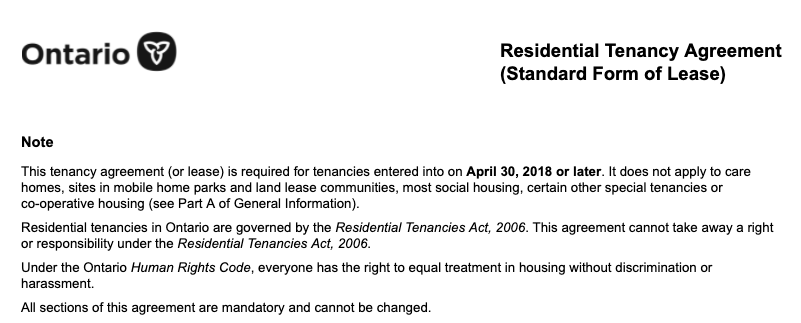
In addition to the Residential Tenancy Agreement, your landlord will need to provide you with a copy of the brochure for new tenants. This outlines both the rights and responsibilities of both you and your landlord.
We’ve included a copy here for your to review.
Read the brochure for new tenants.
Some things to remember:
In most cases your lease term will be for one year.
After this, your lease will automatically convert to a month-to-month tenancy unless you provide your landlord notice in writing two months in advance (on the 10th month). This means you won’t need to do anything but continue to pay your rent on time. If you decide you you want the 12th month to be your last, then don’t wait until the last minute here. If your notice isn’t in by the first day of the month, you will need to wait until the next month.
F.A.Q. - Frequently Asked Questions
-
Rent Control is a process by which the government, at the provincial level, limits the amount a landlord can increase their tenants rent annually. The intention here is to keep living affordable, particularly for lower income residents. In Toronto, any dwelling that was first occupied before Nov 15 2018 falls under rent-control excluding basement apartments, mobile home parks and additions.
-
In Ontario, landlords are generally allowed to increase the rent for a tenant's current rental unit once every 12 months. The amount of the rent increase depends on whether or not a property is currently under rent control.
If a property is not rent controlled, then a landlord can raise the rent by as much as they like.
If a property is under rent control, then the amount they can increase the rent is determined by the Ontario government and is based on the Consumer Price Index (CPI). The CPI is a measure of the rate of inflation in the economy.The maximum amount that a landlord can increase the rent for a tenant's current rental unit is determined by the Ontario government and is based on the CPI. The maximum amount is called the "guideline." The current guideline for rent increases in Ontario is 2.5% for the year 2023. This means that a landlord can increase the rent for a tenant's current rental unit by a maximum of 2.5% this year.
It is important to note that the landlord must give the tenant written notice of the rent increase at least 90 days before the date the increase takes effect. The notice must include the date the increase will take effect, the new rent amount, and the percentage of the increase. The tenant has the right to challenge the rent increase if they believe it is not justified.
-
It is legal for a landlord to ask for post-dated cheques in Ontario as a form of payment for rent. However, there are some rules that the landlord must follow when accepting post-dated cheques. For example, the landlord must provide the tenant with a written receipt for each cheque received, and the landlord is not allowed to cash the cheque until the date written on the cheque.
It is also important to note that the landlord cannot require the tenant to provide post-dated cheques as a condition of renting the unit. The tenant has the right to choose how they wish to pay their rent, as long as it is paid on time and in the agreed-upon manner. If the tenant does not wish to provide post-dated cheques, they can pay their rent using another method, such as electronic payment or cash.
-
In general, there is no additional cost to the tenant for using a real estate agent to help them find a rental property and negotiate a lease. The landlord or property owner pays the real estate agent's commission, which is typically a percentage of the first month's rent.
While it seems logical that a landlord would pass this additional cost onto the tenant through higher rent, it is important to remember that most leases rent for market value, and any property listed on MLS would be required state the amount of commission offered. -
Absolutely!
Asking prices on listings may or me not market value. When we prepare an offer, we look closely at comparable leases for to get a good sense of what our offer price should be. A variety of factors come into play here. Location, size, outdoor space, length of time on the market are all important considerations when determining our price. -
There are a few reasons why you may not see certain apartments on Realm. For example, some landlords may choose not to list their properties on MLS, or they may choose to list exclusively with a particular brokerage. Additionally, some listings may have already been rented out or may be pending lease signing. It's always a good idea to work with a real estate agent who can help you navigate the rental market and find available properties that meet your criteria.
-
In Ontario, the last month's rent deposit is collected by the landlord before a tenant moves in, and it's equivalent to one month's rent. This deposit must be used specifically for the rent of the final month of tenancy, as mandated by the Residential Tenancies Act. The landlord is obligated to pay interest to the tenant on the deposit every year, which is equivalent to the rent increase guideline, thereby ensuring the deposit's value keeps up with potential rent increases.
It's a tenant's reassurance that their last month is covered and a landlord's security for maintaining cash flow continuity at the end of the lease term.
It’s also important to remember that it is only applied to that last month of your tenancy, which does not necessarily mean the end of your lease if it continues month-to-month. -
As a tenant, you typically do not pay a fee to work with a real estate agent. The landlord or property owner is responsible for paying any commission or fees associated with the rental transaction. However, it's important to note that some landlords may choose not to work with agents or may require tenants to pay a fee to cover the cost of a credit check or other administrative tasks.
-
While it is technically possible to work with multiple agents, it's not always the best idea. Working with multiple agents can lead to confusion and duplication of efforts, and it may not increase your chances of finding a rental property. It's better to choose one agent who you feel comfortable working with and who has a good understanding of your needs and preferences. That being said, if you have signed a representation agreement with an agent, you will not be able to work with another unless that agreement is cancelled.
-
Listings on MLS can vary widely in terms of size, location, and amenities. Unlike standard apartment buildings, MLS listings may include single-family homes, condos, and other types of properties. Additionally, MLS listings are typically managed by individual landlords or property owners, rather than a management company. This means that the application and screening process may differ from what you would expect when renting from a larger building. Working with a real estate agent can help you navigate these differences and find the right rental property for you.
-
If your Toronto landlord is a foreign owner, you are required to withhold a portion of your rent and remit it to the Canada Revenue Agency (CRA). Specifically, tenants must withhold 25% of their monthly rent and submit this amount to the CRA by the 15th of the following month. Additionally, you will need to file an NR4 tax form detailing the withheld amount and submit this form to the CRA as well.
Failure to comply with these requirements can result in penalties and interest charges for the tenant. Therefore, it is essential to determine whether your landlord is a non-resident for tax purposes. If your landlord is a foreign owner, ensure you follow the necessary steps to withhold and remit the appropriate amount to the CRA to avoid any potential legal or financial issues.
If you have questions, please reach out to us.
For more information on your rights and responsibilities as a tenant, see the landlord and tenants act.
Do you have any other questions?
Contact us, or book a call with me below.
Ready for the next step?
Book an appointment with me below and we’ll get started!